What 4,000 Live Job Postings Tell Me That Your Workforce Study Can’t
By Devin Hillsdon-Smith | Hyphen Strategies | www.hyphenstrategiesllc.com
Every site selection engagement I’ve worked on in the last fifteen years has involved some version of the same conversation. A corporate client asks whether a region has the workforce they need. The local EDO produces a slick deck — crisp visuals, compelling headline numbers — and somewhere in the middle there’s a slide that says some variation of “deep pool of available skilled workers.” The client nods. We move on. And somewhere between the LOI and the ribbon-cutting, someone gets a rude awakening about what the labor market actually looks like.
I’m not indicting EDOs. Most of the workforce claims in those decks are technically true, drawn from real data — QCEW, OEWS, ACS commuter flows, maybe a custom workforce study. The problem is that those data sources are 12 to 18 months old by the time they reach a conference room. In a labor market that moved as fast as it did between 2020 and 2024, 18 months might as well be a geological epoch. And even in a “normal” market, a lot can change between when BLS collected that data and when your client is trying to hire 600 people.
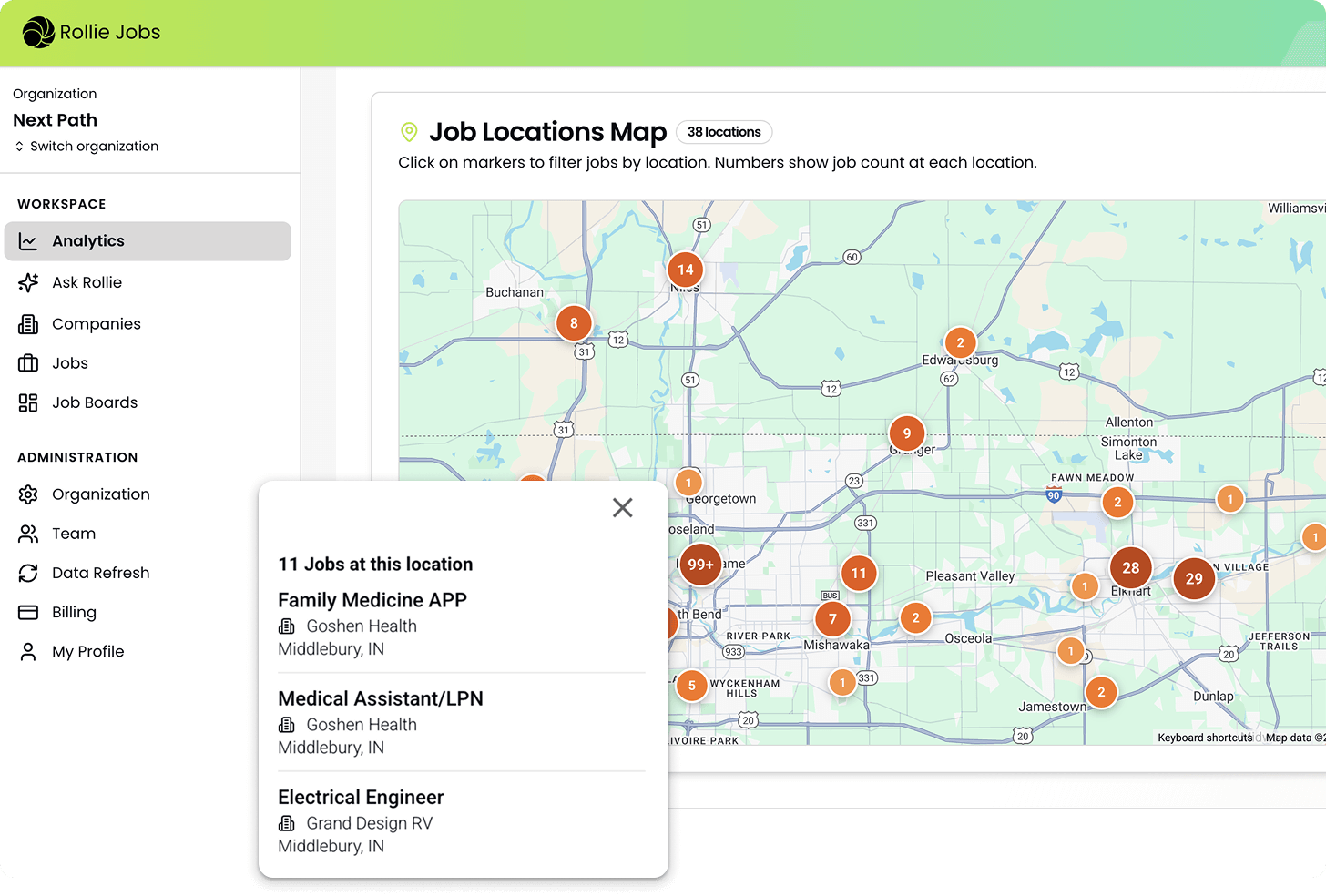
I’ve spent some time recently exploring a platform called Rollie Jobs — a labor market intelligence tool built around live job posting data — and it’s prompted me to rethink where the traditional toolkit has a gap.
The Data Freshness Problem
Site selectors live and die by data quality. We run fatal-flaw analyses, operating-cost benchmarks, and infrastructure screens — most of which have reasonably current, reliable sources. Utility rate schedules are updated regularly. Property tax data is accessible. Real estate market data moves fast.
Labor is the exception. The gold standard — Bureau of Labor Statistics Occupational Employment and Wage Statistics — is published annually, with data collected over a rolling 12-month period. By the time a client is using it to model a 20-year P&L, they’re pricing a future workforce against a past market. For a labor-intensive manufacturing operation where payroll represents 30–40% of operating cost, a $2–$3/hr error in your wage assumption doesn’t just move the needle. It changes the decision.
What Rollie does is index job postings at scale — currently tracking several thousand companies with tens of thousands of active listings — pulling structured data on job title, location, posted salary range, requirements, benefits, and employment type, all tagged with the date the posting went live. It’s not a replacement for QCEW. It’s a real-time overlay that tells you what employers are actually paying today to attract specific workers in a specific market.
Three Ways This Changes My Workflow
First, wage benchmarking gets a ground-truth check. When I'm building an operating-cost model for a client evaluating two finalist sites, I now run a parallel check against live posting data. If my BLS-derived wage estimate for CNC machinists in MSA A is $24.50/hr but active employer postings are clustering between $27 and $31, that model is wrong — and the client's site decision may be wrong with it. The posting data doesn't replace the statistical baseline, but it tells me whether I'm working with a number the market has already moved past.
Second, labor competition analysis gets specific. The question "who else competes for your workforce in this market?" is one I've always had to answer with a combination of Dun & Bradstreet pulls, WARN Act tracking, and educated guesswork. With a live jobs index, I can run a targeted query — maintenance technicians within a 30-minute commute shed, on-site only, posted in the last 90 days — and get an actual employer list with hiring velocity attached. That employer list becomes the foundation of a competitive labor analysis that's grounded in real behavior rather than industry classifications.
Third, hiring velocity is a signal I wasn't capturing before. A region where job postings for your target occupations are accelerating is a tightening market. One where they're flat or declining may represent an emerging opportunity — workforce availability improving, competition for talent cooling. For a client 18 months from opening a facility, that forward-looking read on market direction matters more than a point-in-time snapshot.
Caveats for the Practitioner
I'll be direct about the limitations, because a practitioner's perspective isn't worth much if it's just a sales pitch.
Salary range data is inconsistent. States with wage transparency laws — Colorado, California, New York, Washington — yield good posting-level salary data. Indiana, Texas, and much of the Southeast do not require disclosure, so coverage is thinner in exactly the markets where I do a lot of work. You can still draw directional conclusions, but you can't build a tight benchmark off sparse data.
Job postings also overstate demand. Companies repost, template, and pipeline-hire. A position that's been open for 120 days may represent a genuinely hard-to-fill role or it may represent a recruiter who forgot to take the listing down. Deduplication and aging filters help, but you're still working with a signal, not a census.
And critically, live job postings tell you nothing about the passive workforce — the people who aren't looking but would consider the right opportunity. For large greenfield projects where you need to move the needle on labor availability, a Rollie analysis tells you about the competitive landscape; it doesn't tell you whether your talent acquisition team can actually source a pipeline.
What This Means for the Toolkit
Site selection has always been a discipline that rewards practitioners who can integrate multiple data sources into a coherent picture. The practitioners who do this well don't pick one source and defend it — they triangulate. QCEW tells you the statistical baseline. WARN Act tells you what's being displaced. Local workforce boards tell you what's in the training pipeline. And now, live job posting intelligence tells you what the market is doing right now.
Rollie fits in that stack as a real-time labor market layer — highest value at the short-listing and due diligence stages, when the questions get specific and the stakes get real. Used well, it's the kind of tool that makes the "deep talent pool" slide in the EDO deck either credible or uncomfortable. In my experience, knowing which one you're looking at before your client commits capital is the whole job.

Devin Hillsdon-Smith is the founder and principal consultant of Hyphen Strategies, LLC, a boutique industrial site selection and economic development consulting firm based in Carmel, Indiana. Hyphen Strategies advises corporate occupiers and economic development organizations on location strategy, workforce intelligence, and site readiness across manufacturing, logistics, data center, and energy verticals.